
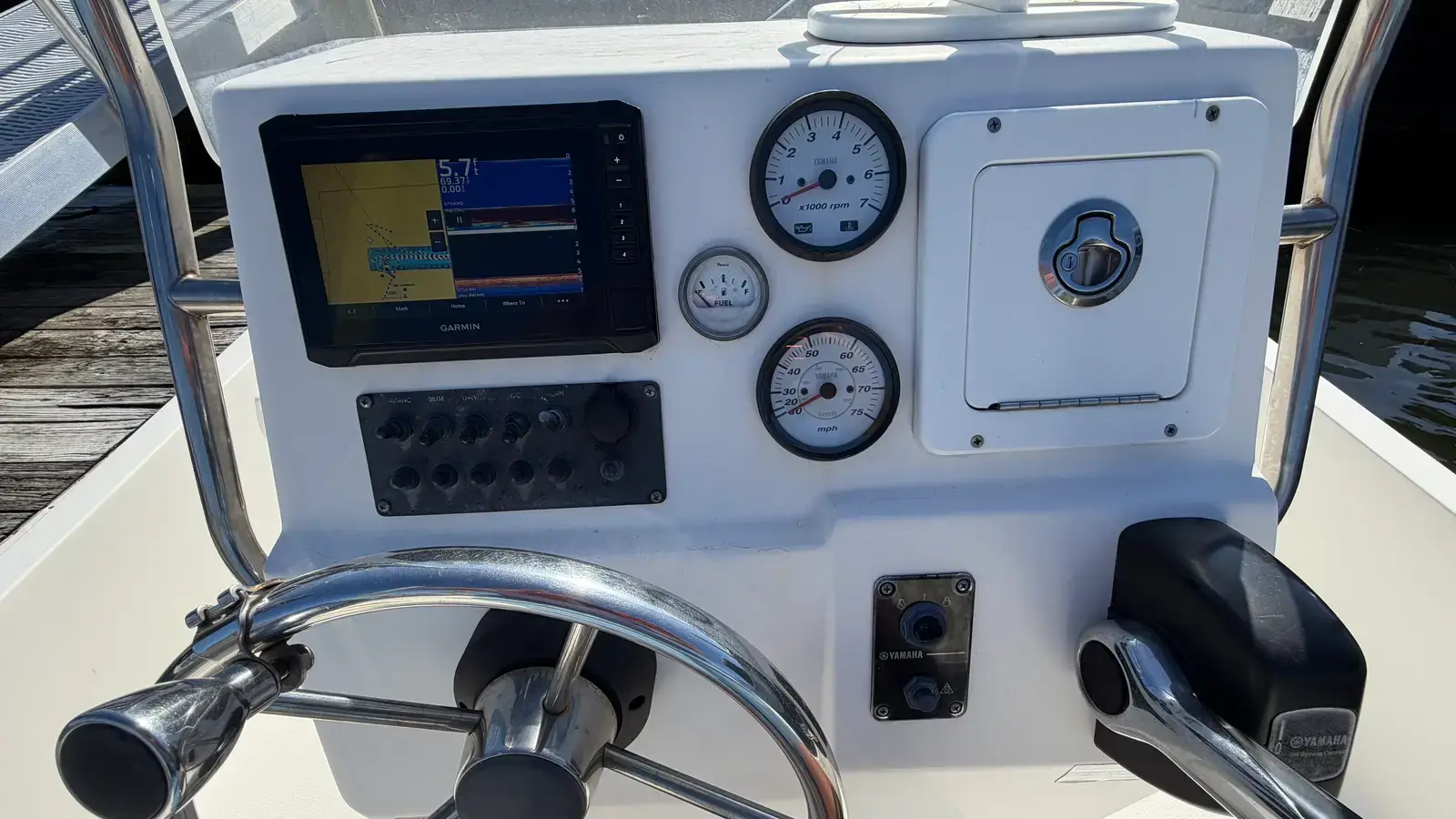
Check these, in this order
- The breaker or switch panel. Boat panels get bumped. Make sure the circuit is on and the breaker has not tripped.
- The inline fuse. Most displays have a fuse in the power cable within a foot or two of the unit. Pull it and look.
- Battery voltage. Below about 11.5 volts, many displays will not boot or will reboot on their own. A weak battery looks exactly like dead electronics.
- The plug on the back of the unit. Unplug it, look for green or white crust on the pins, plug it back in firmly.
- The ground. A loose or corroded ground at the bus bar or the battery will make a unit flicker, reboot or do nothing.
- Everything else on that circuit. If the radio and the plotter both died at once, the problem is upstream of both of them.
When the unit powers up but something is wrong
If the screen comes on but the sonar shows nothing, the transducer or its cable is the first suspect. If the GPS has no fix, give it a few minutes with a clear view of the sky; if it still has nothing, the antenna or its cable is the suspect. If engine data is missing, the NMEA 2000 network has lost power or a connector has corroded.
A unit that reboots the moment the engine cranks is a voltage problem, not a unit problem. The starter pulls the battery down and the electronics let go.
When to stop and call
Stop if a wire is hot to the touch, if anything smells burnt, or if a breaker trips again the moment you reset it. Those are faults that need a meter and someone who knows where to look.
If you have checked the list and the unit is still dead, it may genuinely have failed. It happens, but it is rarer than people think. A technician can confirm it in a few minutes before you buy a replacement.
Questions people ask next
Why does my chartplotter keep rebooting?
Low voltage or a weak connection. Below about 11.5 volts many displays restart on their own, and a corroded plug or ground does the same thing. Check the battery with the engine off, then the plug on the back of the unit, before suspecting the display.
How do I know if the fuse is blown?
Pull it and look. Most displays have an inline fuse in the power cable within a foot or two of the unit; a blown one shows a broken wire or a dark mark inside. If it blows again as soon as you replace it, stop and have the circuit tested; something downstream is shorted.
Is it worth repairing an old chartplotter?
If the fault is power or a connection, yes, because the fix is cheap and the unit is fine. If the display itself has failed, a technician can confirm that in a few minutes, and the money is usually better spent on a current unit with up-to-date charts.

Mobile marine electronics, diagnostics and rigging across New Hanover County, NC. General guidance on how boat systems work; for your boat, call (910) 200-8617.